How to Read My Eye Exam Results
How to Read Your Eyeglasses Prescription
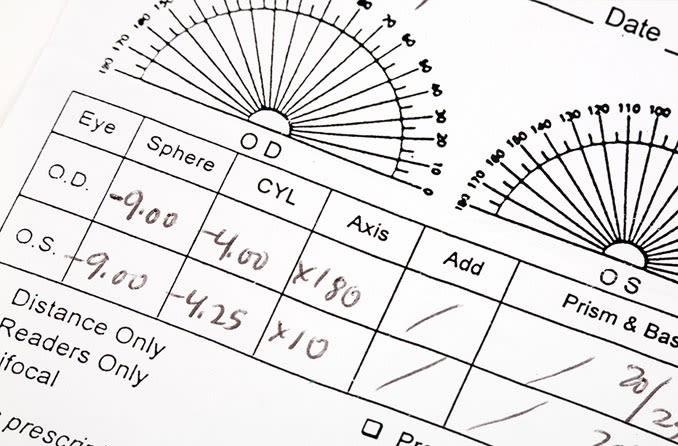
Making sense of your eye prescription chart
The numbers on your eyeglass prescription relate to the shape of your eyes and force of your vision. They tin can help you effigy out whether y'all have nearsightedness, farsightedness or astigmatism — and to what degree.
If you know what to look for, you tin make sense of the numbers and abbreviations on your prescription chart.
OD vs. Os: I for each heart
Center doctors apply the abbreviations "OD" and "OS" to denote your correct and left eyes.
Your eye doctor may requite y'all a paper prescription that looks something like this. 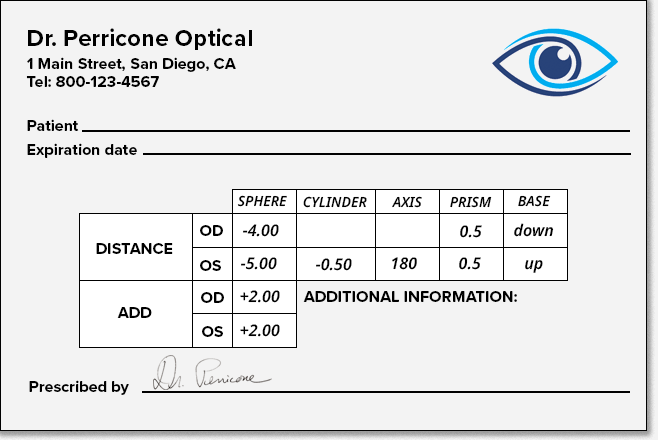
-
OD is your right middle. OD is brusk for oculus dexter, the Latin phrase for "right eye."
-
Os is your left eye. Bone is short for oculus sinister, Latin for "left heart."
Your vision prescription may as well have a column labeled "OU." This is the abbreviation for oculus uterque, which means "both eyes" in Latin.
These abbreviated terms are mutual on prescriptions for glasses, contact lenses and eye medicines, but some doctors and clinics accept opted to modernize their heart prescriptions by using RE (correct center) and LE (left heart) instead of OD and OS.
The information for your right eye (OD) always comes earlier the information for your left eye (Bone). Eye doctors write prescriptions this way because, when they face yous, they see your right centre on their left (get-go) and your left eye on their right (2d).
Sphere (SPH)
Sphere indicates the corporeality of lens power prescribed to correct nearsightedness or farsightedness. Lens power is measured in diopters (D).
-
If the number under this heading comes with a minus sign (–), you are nearsighted.
-
If the number under this heading has a plus sign (+), you are farsighted.
The term "sphere" means that the correction for nearsightedness or farsightedness is "spherical," or equal in all meridians of the eye.
Cylinder (CYL)
Cylinder indicates the amount of lens power needed for astigmatism. It always follows the sphere ability on an eyeglass prescription.
The number in the cylinder column may accept a minus sign (for correction of nearsighted astigmatism) or a plus sign (for farsighted astigmatism).
If nothing appears in this cavalcade, you either don't have astigmatism, or your caste of astigmatism is so small that it doesn't demand to be corrected.
The term "cylinder" means that this lens power added to correct astigmatism is not spherical, but instead is shaped and so one meridian has no added curvature, and the meridian perpendicular to this "no added ability" meridian contains the maximum power and lens curvature to right astigmatism.
Meridians of the heart are determined by superimposing a protractor calibration on the centre'southward front surface. The 90-caste meridian is the vertical pinnacle of the eye, and the 180-degree pinnacle is the horizontal meridian.
Meridians of the centre are determined by superimposing a protractor scale on the eye'southward front surface. The 90-degree meridian is the vertical meridian of the heart, and the 180-caste acme is the horizontal peak.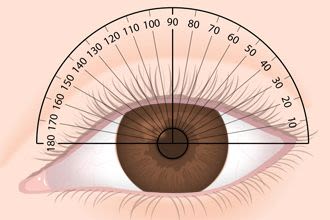
Axis
Axis describes the lens height that contains no cylinder ability to correct astigmatism.
If an eyeglass prescription includes cylinder ability, it as well needs to include an axis value, which follows the cylinder power.
The axis is divers with a number from 1 to 180.
-
The number 90 corresponds to the vertical meridian of the eye.
-
The number 180 corresponds to the horizontal superlative of the centre.
The axis is the lens meridian that is 90 degrees away from the tiptop that contains the cylinder ability for astigmatism correction.
Add
"Add" is the added magnifying power applied to the bottom part of multifocal lenses to correct presbyopia — the natural farsightedness that happens with age.
The number appearing in this section of the prescription is ever a "plus" power, even when y'all don't see a plus sign. Generally, it will range from +0.75 to +3.00 D and volition be the same power for both eyes.
Prism
This is the amount of prismatic power, measured in prism diopters ("p.d." or a triangle when written freehand), prescribed to compensate for eye alignment bug.
Only a small percentage of eyeglass prescriptions include a prism measurement.
When present, the amount of prism is indicated in either metric or partial English units (0.5 or ½, for instance), and the management of the prism is indicated by noting the relative position of its "base" (thickest edge).
Iv abbreviations are used for prism direction: BU = base up; BD = base downwards; BI = base in (toward the wearer's nose); BO = base of operations out (toward the wearer's ear).
How they're measured
Sphere power, cylinder power and add ability e'er appear in diopters. They are in decimal class and generally are written in quarter-diopter (0.25 D) increments.
Axis values are whole numbers from ane to 180 and signify simply a meridional location, non a ability.
When prism diopters are indicated in decimal grade, typically only ane digit appears afterward the period (eastward.thou., 0.5).
An example eye prescription chart
Even so confused? Let'south await at an case prescription chart:
| SPH | CYL | Axis | Add together | Prism | |
|---|---|---|---|---|---|
| OD | -2.00 | SPH | +2.00 | 0.five BD | |
| OS | -1.00 | -0.50 | 180 | +2.00 | 0.5 BU |
In the right eye (OD), the centre doctor prescribed:
-
-two.00 D sphere for the correction of nearsightedness.
-
No cylinder power or axis, which means no astigmatism is present. This doctor chose to write "SPH," to confirm the right centre is existence prescribed only spherical ability. Some doctors volition add together "DS" for "diopters sphere" and others volition leave it bare.
The left middle (OS) was prescribed:
-
-1.00 D sphere for nearsightedness correction.
-
-0.50 D cylinder for the correction of astigmatism.
-
A cylinder ability with an centrality at the 180 meridian. This means that the horizontal (180-caste) pinnacle of the eye has no added ability for astigmatism and the vertical (90-degree) peak gets the added -0.fifty D from the cylinder cavalcade.
Both eyes were prescribed:
-
An "add ability" of +2.00 D for the correction of presbyopia.
-
Prismatic correction of 0.v prism diopter in each eye. In the right eye, the prism is base down (BD); in the left centre, information technology's base up (BU).
Your eye physician may too write specific lens recommendations on your eyeglass prescription. They might advise anti-cogitating coating, photochromic lenses and/or progressive lenses to give you the about comfortable vision correction possible.
SEE RELATED: How "bad" is my prescription?
Can eyeglass prescriptions be used to purchase contact lenses?
No, yous cannot apply your glasses prescription to buy contact lenses.
An eyeglass prescription only works for the purchase of eyeglasses. It does non contain sure information that is crucial to a contact lens prescription.
That information tin only be obtained through a contact lens fitting, an boosted process that tin can exist performed during your eye doctor visit.
Eyeglass lenses are positioned at a distance from the eyes, while contacts rest direct on the optics. That distance affects the lens power required for optics to focus properly.
In addition to the data in an eyeglass prescription, a contact lens prescription must specify the base (central) curve of the back surface of the contact lens, the lens diameter, and the specific manufacturer and brand proper noun of the lens.
Also, the power of an eyeglass prescription often is modified when determining the all-time contact lens power. This is because eyeglass lenses are worn some distance (unremarkably nearly 12 millimeters) from the surface of the eye, whereas contact lenses remainder directly on the cornea of the eye.
An accurate contact lens prescription can be written only after a contact lens fitting has been performed and the prescribing doctor has evaluated your eyes' response to the lenses and to contact lens wear in full general.
Run across ALSO: Contact lens vs. eyeglasses prescriptions
Your eyeglass prescription is yours to keep
The Federal Trade Commission (FTC) is the U.S. government's consumer protection agency. Their Prescription Release Rule requires that eye doctors give patients a copy of their eyeglass prescription at the end of an centre exam that includes a refraction.
The Prescription Release Dominion is intended to let the "portability" of your eyeglass prescription, giving you the freedom to buy glasses from whatsoever vendor of your choice.
Your eye doctor must give you lot a re-create of the prescription whether or not you inquire for it. Eye doctors may non condition the release of your prescription on your agreement to purchase eyeglasses from them, nor may they charge you lot an actress fee to release your prescription.
If you remember your eye doctor has violated this rule, you can report the trouble to the FTC.
Page published in February 2019
Page updated in Feb 2022
Source: https://www.allaboutvision.com/eyeglasses/eyeglass-prescription.htm
0 Response to "How to Read My Eye Exam Results"
Enregistrer un commentaire