Does Equestrain Expense Qualify as Fine Arts for Mn?
Creative person: Evie, graduated 2014 Photographer: greenroomphotography/Kinga Lubowiecka 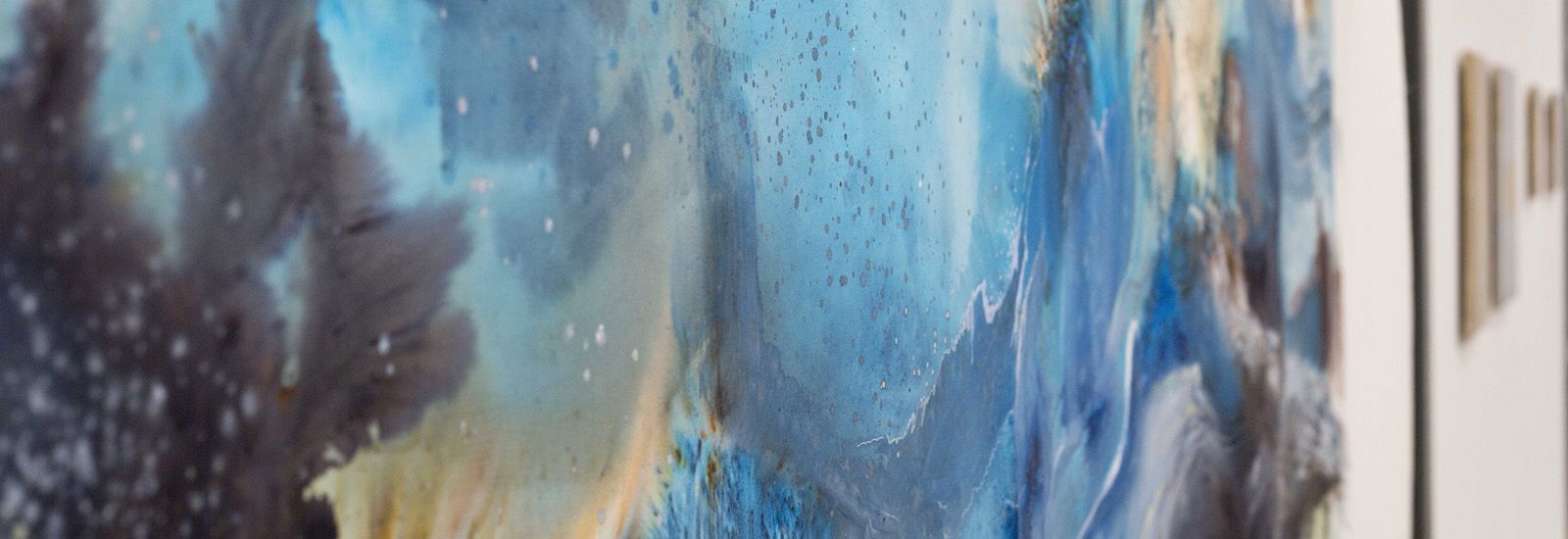
Fine art
- Overview
- Structure
- Admissions Requirements
- Careers
- Fees and Funding
- Studying at Oxford
Unistats information for this class can be found at the bottom of the page
Fine Fine art is the making and study of visual fine art. It educates and prepares students to become artists and to follow other practices that are aligned with the making of art. The curriculum is centred on the individual student'southward potential and imagination.
The Ruskin School of Art offers a three-year studio-based BFA course in which students work alongside each other in collaboratively-organised studios. Whereas many fine fine art courses run in an environment devoted exclusively to fine art and design, Ruskin students, equally members of a collegiate academy, accept the advantage of contact with their contemporaries on all of Oxford'southward other courses.
The Ruskin course aims to develop stiff independent points of view and a mature grasp of the range of critical debate surrounding contemporary art and its many international histories. Oxford's short terms, coupled with the ambitious temper at the Ruskin, suit highly-motivated and resourceful students with a good sense of how to organise their time both in and out of Oxford.
The starting time twelvemonth of the course is structured to introduce students to one another, to the resources of the school and to the staff involved in teaching and running the Ruskin. Students will familiarise themselves with their fellow students' work, take part in group criticism and appoint in intensive dialogue with tutors and visiting artists.
The intimate working environment of the schoolhouse, arranged in two buildings, allows fine art history, theory and criticism to be treated every bit integral to the evolution of studio work. The Ruskin also enjoys a potent and effective relationship with Modernistic Art Oxford (an heady and influential contemporary art space) and students accept total admission to the many exceptional Academy libraries and museums, including the Ashmolean and the Sackler Library.
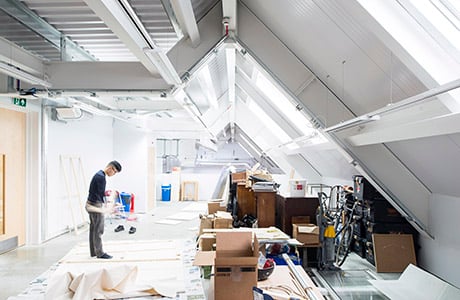 | "Unlike ... other art courses in the Great britain, the Ruskin does non require you to specialise in whatever particular medium. [And] the interesting blend of bookish and applied that this course offers was perfect for me." "My time at the Ruskin was extremely positive... The majority of the grade is structured with contained practice, only the studio surroundings means at that place are always people around to bounce ideas off... The sense of community and support at Ruskin is what makes information technology stand out, and the form volition aid nurture your practice in a caring and challenging style." |
A typical week
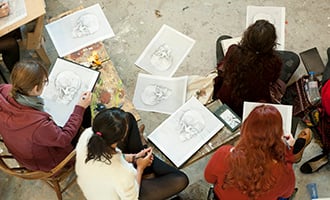
Most students' weeks volition typically consist of several, or all, of the following: a one-to-one studio-based tutorial focusing on the private pupil'south art work, a group critique of pupil art work, a skills-based workshop, a history and theory lecture and seminar, and a talk past a visiting speaker. Yous volition spend much of your time working in your ain studio spaces, where you will be supported by specialists in the fine art-making techniques bachelor at the Ruskin.
Tutorials are usually 1:1 with a tutor. Typically at that place are 10-xx students in a grouping critique (in which 4 students nowadays their work, and give-and-take is guided past two tutors). There are normally no more than than 12 students in whatsoever workshop or seminar and effectually 30-xl for lectures and visiting speakers' talks. Well-nigh instruction is delivered by staff who are dedicated tutors in their subject. Many are leading artists and writers with years of experience in didactics and inquiry. Some teaching may exist delivered by postgraduate students who are studying at doctorate level.
To find out more than virtually how our teaching year is structured, visit our Bookish Year page.
Course structure
| Twelvemonth 1 | |
| COURSES Students develop their studio piece of work in discussion with the school'due south kinesthesia, tutors and visiting staff. They are allocated a tutor at the outset, who monitors progress, sets targets and directs them in their studies. Piece of work is regularly presented and discussed at grouping critiques involving staff and students from across the schoolhouse. Alongside this, workshops and projects designed to introduce a range of techniques and approaches are offered throughout the twelvemonth. In addition, students attend taught applied classes in human anatomy also as lectures, seminars and tutorials in the history and theory of visual culture. Experimentation is highly encouraged. | Cess Practical studio-based work, including human anatomy; 3 submitted essays in the history and theory of visual culture |
| YEARS 2 AND three | |
| COURSES Years two and three are similar in structure (with the exception of Beefcake), and continue the tutorial system introduced in the first twelvemonth All students are required to proceed the study of art history and theory and to submit 3 essays during the grade of the second yr. In the first term of the tertiary year, Finalists agree with their tutor on the title and subject field of an extended essay. This vi,000-word essay is submitted at the end of the 2nd term of the third year equally part of the Last Test. Students are expected to establish a strong bond between the interests of the essay and their studio studies. | Cess(YEAR ii) Submission of three history and theory essays, which are assessed as office of the Final Test ASSESSMENT(YEAR 3) An extended essay; a portfolio of work fabricated during the 2nd and tertiary years and an accompanying exhibition |
Visit the Fine Art website for more information.
Academic requirements
| A-levels: | AAA (or AAB for candidates who have undertaken or completed a mail-eighteen Art Foundation course*) |
| Advanced Highers: | AA/AAB |
| IB: | 38 (including core points) with 666 at HL |
| Applied General Qualifications: | BTEC and Cambridge Technical Extended Diplomas: DDD UAL Applied General Extended Diploma (2018-): HM (High Merit) (Equally the Fine Fine art degree also includes a substantial history and theory component, applicants with vocational qualifications will need to demonstrate that they have the critical, research and essay-writing skills required for bookish study at Oxford.) |
| Or any other equivalent (see other Britain qualifications, and international qualifications) | |
* Post A-level applicants with AAB at A-level (or equivalent) will exist expected to submit an outstanding portfolio and to reach at to the lowest degree a Merit or equivalent on their Foundation course.
If applicants are studying for the UAL Level 3 Applied General Extended Diploma in Art and Design they would be expected to reach a High Merit. As the Fine Art degree likewise includes a substantial history and theory component, such applicants will be expected to have successfully completed a range of modules that include art history.
Wherever possible, your grades are considered in the context in which they have been achieved. (Run into further information on how we use contextual information.)
Subject area requirements
| Recommended: | The Ruskin recommends that candidates have studied Art at A-level or equivalent qualification. It is highly recommended that candidates accept undertaken a postal service-18 Fine art Foundation course earlier applying. |
Applying
All candidates must follow the application process as shown in applying to Oxford. The information beneath gives specific details for students applying for this course.
Portfolio submission
| Clarification: | Portfolios must be submitted digitally, via an online platform called SlideRoom , which will be made available on the Ruskin website shortly after the application deadline; candidates who have submitted a UCAS application to report for the BFA programme will be emailed the link to SlideRoom. In that location is no prescription for the content of a portfolio: candidates should aim to include a range of work which gives a sense of their artistic and intellectual interests and an sensation of gimmicky art. You lot will be able to upload your portfolio with videos, photographs, audio files and PDFs. Please encounter the Ruskin website for further information.* |
| Submission deadline: | 6pm, Thursday 3 Nov 2022 |
*Read more nearly the portfolio
Interview and practical test
TBC for applicants applying for entry in 2023.
What are tutors looking for?
All applicants are required to submit a portfolio of their art work. Tutors are looking for work that goes beyond the mere fulfilment of schoolhouse curricula. Tutors will seek show of a breadth of engagement, a sense of purpose and an emerging artistic vocalization in the way the portfolio is edited. If you are shortlisted you volition be asked to present a small-scale number of additional contempo pieces of your work to hash out during interview.
For more than detail on the option criteria for this course, please see the Ruskin School of Art website.
Careers
After graduation, most students go along to piece of work in the arts sector, as practising artists, teachers, curators and art writers, fabricators and technicians, in public and individual museums and galleries, community arts organisations and for culture and heritage councils and institutions. Many also pursue careers in academia, architecture, and the film and digital media industries.
Many Ruskin graduates have won or been shortlisted for prestigious awards and prizes beyond many media. In 2019, Nazia Khan (BFA 1990) represented Islamic republic of pakistan at the Venice Biennale, and Nathaniel Mellors (BFA 1999) represented Finland at that place in 2017. In 2016, Helen Marten (BFA 2008) won the Turner Prize and the Hepworth Prize for Sculpture, and Elizabeth Price (BFA 1988) won the Turner Prize in 2012. Paul Franklin (BFA 1989) was awarded the Oscar for Visual Effects for his piece of work on the science fiction picture Interstellar in 2015. Conrad Shawcross (BFA 1999) won the Jack Goldhill Award for Sculpture in 2014.
Ruskin Alumni were included amongst the Bloomberg New Contemporaries in 2017, 2016, 2015 and 2014 including Lucy Mayes, Ruth Spencer Jolly, Melanie Eckersley and Emily Motto. Nathaniel Whitfield (2016/17) was selected to take part in the Whitney Independent Studies Plan in New York. The works of Khushna Sulaman-Barrel and Alvin Ong were included in the BP Portrait Award at the National Portrait Gallery, London in 2018.
Fees
Additional Fees and Charges Information for Fine Art
In the kickoff yr of the BFA course, students are provided with basic materials and more specialist materials are available to buy at cost. In that location is no expectation for students to go far with any boosted equipment or materials across those they may already possess.
Each student receives a materials grant (currently £475) from the Ruskin School of Fine art for each year of the course. Finalists as well receive a further materials grant (£280) for their piece of work in the concluding bear witness. Students in the 2d and third years of the course are expected to meet any additional costs for materials, applying to their higher for back up in the first example. Colleges may as well provide support for student projects and travel, including the optional work feel programme for second year students who take part in the Ruskin'southward Professional Exercise Programme.
Throughout the course, students are able to borrow an extensive pick of equipment on a sign-up basis. In the kickoff calendar week of their first term, all students pay an equipment eolith of £100. The deposit system is to secure against the borrowing of departmental equipment (and library books) and the eolith is returned to the student at the cease of the course.
Concluding year students unremarkably phase a public exhibition of their work following the final test and they collectively raise funds for this through sponsorship, fine art sales and other activities.
Pinnacle-rated art school in the Uk
The Complete University Guide placed the Ruskin as the leading art school in the UK in 2020, 2019, 2017, 2016 and 2015.
Feel inspired?
If you'd similar to read around the subject area, the following are a good identify to start: Julieta Aranda ed., What is Gimmicky Fine art; Roland Barthes, Camera Lucida: Reflections on Photography; Hito Steyerl, The Wretched of the Screen; Julian Stallabrass, Contemporary Art: A Very Short Introduction and Audre Lorde, The Master's Tools Will Never Dismantle the Primary's House.
You might like to look at some online resource, such as ArtForum or the repository of moving paradigm and sound art, UBU Web. There are also lots of fascinating journals, including due east-flux, Frieze and ArtRabbit. We recommend prospective students attend exhibitions and look at art works as much as possible. Public art galleries like Tate Modernistic, Whitechapel, and the Serpentine in London, the Ikon in Birmingham, the Liverpool Tate, the Whitworth in Manchester, the Baltic in Gateshead, the Arnolfini in Bristol and Tramway in Glasgow are all excellent places to see contemporary art. The Tate Modern website as well has links to articles and videos on contemporary art and artists.
Source: https://www.ox.ac.uk/admissions/undergraduate/courses/course-listing/fine-art
0 Response to "Does Equestrain Expense Qualify as Fine Arts for Mn?"
Enregistrer un commentaire